Wednesday, October 13, 2010

Trip Report: Nicholas Dean Lodge (Sept. 19 - 25, 2010)

Gorgeous B.C. Steelhead

We recently received an excellent report from Jim Christensen and Greg Anderson who fished Nicholas Dean Lodge late last month. Here is Greg's report:

"We had a great trip. We landed 18 Steelhead between us plus 3 cohos and numerable trout. Fished the Upper Copper, Klore, the Upper Kalum and a few other remote rivers. We had some great hikes and only saw one other fisherman while we were fishing throughout the week. Saw wolves on the Upper Copper. Our guide (Jeff) was great. The food was great. We lucked out with the weather...no rain the first 3 days and then a little weather on the 4th. Friday it rained and the rivers were blown out as we left. Chad the lodge host was great."

Thanks Jim and Greg for a great report!

Bull Trout

Yes, it does rain in the coastal rainforest of BC!

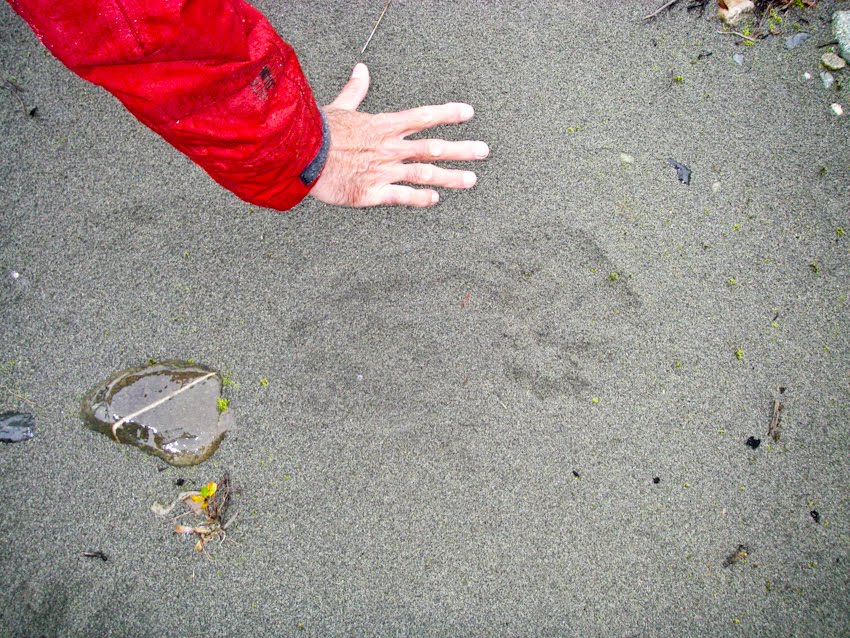
Big bear tracks...


Friday, September 10, 2010

Trip Report: Tarpon Cay Lodge (Aug. 14 - 22, 2010)

Bill definitely needed two hands to handle this whopper

The following joint report has just come in from long time fishing friends Bill Ninke (New Jersey), Bob Huddleston (Minnesota) and Gary Fritz (Montana) who spent this week at Tarpon Cay Lodge. Bill and Gary are repeat clients, having spent a week last August at TCL. Bob, upon hearing their glowing reports from last year, decided to join them this year.

“To maximize our fishing opportunities, we booked the option where we each had an individual guide and boat each day. We also chose a schedule so that each of us spent two consecutive days with each guide. This proved to be a wonderful arrangement. Each guide is excellent but has a somewhat different style, giving us a variety of experiences.

Our three guide amigos – Martin, Cresp, and Carlos

Convinced that the baby tarpon would always be available, we tried for larger tarpon down near the light house the first four mornings. Winds were fair the first and third mornings and very calm the second. We caught some 20 and 30 pounders those three days. Bill landed the biggest that Carlos estimated was near 60 pounds.

Here’s Gary’s narrative.

‘From less than 200 feet away I saw the fish roll. Bill, who was 80 feet away, made two false casts and landed his fly next to the fish. The tarpon instantly ate the fly and the battle was on. That cast would not have happened the previous year because Bill was not a distance caster. He took the time and made the effort to become a vastly better caster in salt water and his lessons and practice his last year paid off with that gorgeous tarpon, as well as others. I’m particularly proud of Bill because, as a guide, I see tons of anglers, especially older ones, who cannot or will not improve their fishing experience by becoming better casters. Bill wanted to do this and did.’

We ran down to the light house area again the fourth morning but the winds were too high once we got there and we went back to baby tarpon. Bob and Gary discovered an easy test determine whether a try for the bigger tarpon was merited. They stood in the gap between the east end of the hotel and the next building first thing in the morning. If they felt a distinct breeze, it was going to be too windy to try. If near dead calm, it was off to the light house.

The last three mornings it was fishing for babies in the creek mouths and creeks. Most afternoons we had showers. One afternoon was entirely wiped out and another was cut short by two hours. Afternoon tides were quite low so the baby tarpon were on the flats. Gray skies and wind made finding fish and getting them to eat very difficult. But, we still all caught tarpon. Most were in the normal size range for TCL fish.


Occasionally though, one of us would jump a surprisingly large tarpon.

Bob’s surprise in the mangroves

Bill’s surprise on the flats

The showers, thunder, and lightning flashes provoked an interesting discussion one evening. Bill and Gary claimed that if you counted the seconds from seeing the lightning until hearing the thunder that this gave an indication of how far away the lightning struck. Each second indicated one mile. Bob claimed this was wrong. Sound travels at about 1100 feet per second (approximately one-fifth of a mile per second). Therefore, you need divide the time in seconds by five to get the distance in miles. Bill and Gary checked this out upon returning home and confirmed that Bob is right. Now they are trying to blot out the many occasions when they should have been scared but weren’t.

The food at TCL was superb. Beto (who serves as host, waiter, cook, bartender, and tour guide} prepared many luscious seafood dishes along with some local favorites using beef and pork. Baby octopus were in season and were incorporated in several excellent cerviches.

Beto, the Renaissance Man

At lunch one day, Beto promised to prepare his famous Guacamole recipe as an appetizer for dinner. Bob ventured that he had an excellent recipe too. So Beto invited Bob to join him in the kitchen that evening to prepare Bob’s version also. The two versions emerged and Bill and Gary were charged with deciding which was better. They wisely chose to completely consume both versions and declare the competition a tie.

Beto volunteered to take us on a tour after lunch one day, an invitation we gratefully accepted. We drove the waterfront and side streets of San Felipe, visited the nearby town of Rio Lagartos with its swimming cenote, stopped off at a wonderful white sand beach east of Rio Lagartos, and finished with a drive through the evaporation lakes and salt collection in Rio Colorado. We highly recommend this tour if you go to TCL.

While we took an enormous number of different fly pattern with us, we actually used very few of these. For the larger tarpon, we used chartreuse Toads tied on 2/0 Gamakatsu SC15 hooks, Sea Habits in the Sardina coloring tied on 1/0 Tiemco 600SP hooks, and chartreuse and white Rob’s Receivers also tied on the 1/0 Tiemco 600SP. We had some red and white Whistlers along but never got around to using them.

A touch of Chartreuse attracted the larger tarpon

For the baby tarpon in the creek mouths and bays, we used mostly smaller Toads tied on size 1/0 and size 1 Gamakatsu SC15 or SS15 hooks (chartreuse, purple, tan and orange). Additionally we used various colors of Seaducers on 1/0 SS15 hooks and rabbit strip baitfish on 1/0 SC15 hooks. A foam-backed version of a Seaducer with added eyes to mimic a shrimp worked particularly well.

Toads and Baitfish

Seaducers

For fishing the flats in the afternoons with the very low tides, very small flies were required so as not to spook the hell out of the fish. The rabbit strip baitfish rode high enough in the water so that it still worked. A foam-headed Toad on a size 1 hook did well as did two of the guide Carlos’ flies – a small black gurgler and a small deer hair slider. If we go back to TCL, we’ll have a much wider selection of very small flies than we took with us this trip.
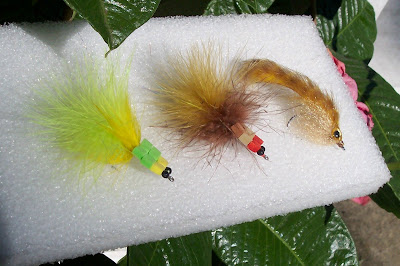
Foam-headed Toads and Baitfish

Carlos’ Patterns

As a summary of our experiences, here’s a direct quote from Gary.

‘While I'm not sure who was the bestest or caught the mostest, I can say that I had a great time at San Felipe. As Carlos would always say, I had “good action”. He and I did a lot of fishing in the creeks where the “action” is amplified by the close quarters. I learned a lot about landing tarpon that were leaping over, around and through the brush.

While I thoroughly enjoyed each day, perhaps my favorite was a day with Carlos when we fished to tarpon exploding on bait fish just offshore from some sandy beaches and then went up several creeks to have fish wrap my line around branches.

I'm an anti-fish counter, but the first afternoon I had 17 babies eat the fly, jumped 12 and landed 7. And that's in a few hours of fishing. Of course, numbers are a woefully poor measure of a fishing trip. I had a ton of opportunities to catch fish, fished with some first class Mayan guides that I can call amigos, got to know a little bit about a spectacular marine environment, became friends with a irrepressibly good natured Mayan cook who made the best assortment of sea food that I've ever had, stayed in a little fishing town with no crime and no other gringos, learned new stuff about tarpon and the flies they eat, and enjoyed all of this with two great friends. Now that's a good fishing trip’

What more can we say?”

After the showers

Friday, September 3, 2010

Trip Photos: Tarpon Cay Lodge by Gary Kramer


We are excited to have received a few photos from client, writer, and photographer Gary Kramer. This is Gary and his friends' 3rd season fishing with us. Gary is a renowned outdoor writer/photographer that is continually published in almost every major outdoor sporting publication. Over that past couple of years, Gary has published articles about Tarpon Cay Lodge in Fly Fishing in Saltwater titled "Yucatan Yearnings" (Jan/Feb. 2010 issue) and in Gray's Sporting Journal titled "Tarpon Reclinado" (April 2010).

This past summer, Gary and his group returned to Tarpon Cay Lodge and had stellar fishing for baby Tarpon. They reported many shots at Tarpon each day and, once again, thoroughly enjoyed the entire experience. Thanks again Gary and friends! We look forward to your return visit next season... until then, Fish On!


Friday, August 27, 2010

Isla Blanca Report and Photos

Jim lands a nice Palometa at Isla Blanca...

Here is a nice report sent by Jim Christensen who recently fished Isla Blanca for 5 days...

Hello Keith,

As usual we found lots of fish species to keep us busy. I guess the reason I’ve been going to Isla Blanca so often is the fact that with four key fish species to hunt, one is bound to find something that wants to eat. Although it sometimes took some searching, each day we managed to find snook, tarpon, bonefish and/or permit. The snook and tarpon seemed to like both a very drab (brownish grey) seaducer or one with some root beer to burnt orange crystal chenille underbody. The bonefish and permit went for rag head crab patterns, some weighted some only lightly so depending on water depth. The wind, though not bad, kept us in the mangroves for a couple of days. The tarpon were around so no problem. On calmer days we chased bones and permit. As you know one of the neat things about the IB venue is that there are “options”.

A brief note on tarpon: Ed and I had a period of missing hook-ups on tarpon. Sometimes the hook points were rolled but other times, try as we might, we could not get the hook set. We were both using twisted leaders initially but switched to a standard, single strand, leader and had fewer problems. Could be that our rods were too soft. Anyway a leader change solved the problem (or was it just us).

Our guide took us to several spots that I had not fished before………always something new there. I’d not fished with Enrique on any prior trips. His 25 years of experience was evident …. As with the other guides I’ve used at IB Enrique really knows that area.

The accommodations at the Sea Adventures were fine. It appears that management has tightened things up a bit since last year. By-the-way, it seem that if one leaves a relatively modest tip at the Oysters restaurant they will invite you back on subsequent nights even without the one-time-only ticket.

Soooooo I guess we need to take a look at tides/moon phases for next year. I think Ed is also interested so will check with him.

Best Regards,
Jim

Jim and his Snook landed in a shallow lagoon...

Monday, August 23, 2010

Trip Report: Isla del Sabalo (Aug. 2010)

Robert lands a jumbo baby Tarpon at Isla del Sabalo

We just had a couple of stellar Isla del Sabalo reports come in from repeat customers, Monty (Naples, FL) and Robert (Billings, MT). Both of them fished the Yucatan with us last summer and decided to fish with us again this summer. They reported a "great time, weather, fishing and people were great." Most of the fish were around the bocas (mouth of rivers) and along the shoreline flats. Most of the baby Tarpon were 10 - 12 pounds, but there were some that topped 20, 30, and even 40 pounds! The HOT flies were the Puglisi Tarpon Streamers in hot orange and yellow, or purple and black (size 2/0). Thanks Robert and Monty for the continued business and we look forward to your next trip in summer of 2011!

Monday, August 16, 2010

Recent Trip Report: Isla Blanca


Here is a nice testimonial from long-time customer Ed B. from Sacramento, CA:

Keith,
Isla Blanca! Once again I find myself wishing I was still there. As you know I went twice this year. In June with "new to the salt" friend Bill and in July with Jim. After all, what's not to like about fishing Isla Blanca? It's a relatively close destination, the guides are great and the fishing is varied. If the fishing is off for one species, you can chase another. A few times it was too windy to effectively hunt Permit and Bones on the flats it the morning, so we chased Tarpon and Snook in the quieter back country. We still got in our shots on the flats later in the day when the wind calmed. Sometimes there is some unexpected by-catch as my friend Bill poses with a Pompano which grabbed his crab after a nice cast into a pod of feeding Permit and I landed that Cuberra Snapper blind casting to pockets for Tarpon. No vast numbers of fish were caught on either trip but each day had its points of excitement. This year seemed to be a bit persistent with thunder storms and did get caught in a few downpours. One morning, during a light rain, wondering what kind of fishing we would have, our guide got us into a group of baby Tarpon frantically feeding on baitfish. For at least 20 minutes Jim and I cast to this group boating two each and jumping many more. The last afternoon, Jim and I were on one of the close large flats and many small groups of Permit began to show... At one point I counted 8 spots of nervous water around us with in 100yds. At first the water was barely 2' deep and the fish seemed to spook when someone said "Permit!" You couldn't even start a cast at 80 feet. As we got a little deeper, with allot of finger biting, crouching low and even the guide getting down from his perch and polling from the boat bottom, their spookiness lessened and Jim was able to score on a nice 23"-5.5 lbs.

Once again, thanks for the service, Ed Bielawski

Friday, July 30, 2010

Float Trip 2011: South Fork of the Flathead River (Montana)

I am excited to announce that Angling On The Fly will be hosting a float trip in 2011 on one of Montana's premier dry fly fisheries, the South Fork of the Flathead River. The South Fork flows through the Bob Marshall wilderness and is home to incredible numbers of native West Slope Cutthroat that rise to a dry fly with vigor and Bull Trout that reach massive proportions. This is a full service, multi-day float trip outfitted by Paws Up Outfitters - they are renowned for offering the finest camp experiences in the wilderness. The remote headwaters are reached on horseback, where we will begin floating and fishing up to 50 miles of river during the week. Best of all, Paws Up retains the special permit to operate on this river and this means a week of fishing and camping in solitude.

I have personally made this float trip with Paws Up and was completely captivated by the entire experience. The scenery was breathtaking, while Paws Up provided unparalleled levels of service and amenities at camp. And, the fishing was... honestly, the absolute best Trout fishing I have ever experienced. The "catch-rate per day" was incredible and I was most pleased with the variety of methods that could be used to entice the Trout. Even more, it was exciting to be able to pursue Bull Trout - some of which reach double digit weight. So, I hope you can join me on this amazing wilderness adventure in 2011! Below are the trip details:

Paws Up Outfitters

Program: South Fork of the Flathead River float trip (Bob Marshall Wilderness)
Target Species: West Slope Cutthroat
Other Species: Bull Trout

HOSTED TRIP DETAILS
Date Options: August 1 - 7, 2011
Trip Length: 6 nights camping and 5 days fishing
Group Size: 6 - 8 anglers
Rate: $4,700 per angler (guided fishing) -- OR -- $3,500 per angler (non-guided fishing)
Travel Details: Fly to Missoula, MT

NOTE: "Non-Guided" option receives all of the same services and amenities in camp - full staff service, camp setup/takedown, cooking/meals/beverages, etc... but you and your fishing partner would row your own fishing raft during the day. The South Fork is not very technical river to row and much of the best fishing is done while wading (use the raft for transport and fishing down the river).

Good Fishing to All,
Keith


Tuesday, July 27, 2010

Trip Report from Tarpon Cay Lodge (July 17 - 24, 2010)

Guide Cresp displaying one of Jon's 51 baby Tarpon landed at Tarpon Cay Lodge

We just received a fantastic fishing report from repeat Yucatan customer, Jon H. of San Jose, CA. For the past few years, Jon has made bi-annual trips to Tarpon Cay Lodge and/or Isla del Sabalo to pursue Tarpon. He is an avid Tarpon-holic, as he also makes multiple annual trips to the FL Keys to pursue Tarpon and other flats species.

Well, Jon just returned from a great week of fishing at Tarpon Cay Lodge. Despite the unseasonal windy conditions at San Felipe, he still managed an impressive 51 baby Tarpon landed in a week of fishing. Even more, he said that he jumped and lost equally as many throughout the week. Wow, impressive!

Unfortunately, the windy conditions did not provide an opportunity to successfully pursue the migratory Tarpon last week. This seems to have been a common theme across the Gulf and Caribbean this past spring / summer. Once this wind lays down, the fishing should be excellent. August is normally the lowest wind month, so we have our fingers crossed for some stellar reports on the big Tarpon next month.

Well, thanks again Jon for checking in with us and giving us a nice report about your fishing success at Tarpon Cay Lodge. Good fishing to all and Fish On!

Tuesday, July 13, 2010

Article: Tight Line Nymph Fishing by Bill Carnazzo

Bill Carnazzo, one of N. California's authorities on "Tight Line" nymphing tactics...

Here is a great mini-article written by guide and signature fly tier, Bill Carnazzo. Bill guides on the following Northern California premier Trout fisheries:
  • North Yuba near Downieville
  • Upper Middle Fork American River Canyon, including the following streams in that canyon: Rubicon River (upper and lower); the Middle Fork American above French Meadows; Long Canyon Creek; Wallace Creek; the North Fork of the Middle Fork American; and Duncan Creek.
  • Upper Sacramento River and McCloud River
He applies short line nymph fishing tactics on all of these rivers and has written a very informative piece about this technique. Here it is...

Short Line (aka Tight Line) Nymph Fishing

General points. Short line nymphing is a highly effective method for fishing pocket water—but it requires “paying your dues” in order to master its many nuances. This means a lot of patience and practice over an extended time. There is no silver bullet and no substitute for putting in the time on the water. Once mastered, the short line technique will become intuitive. What follows is a brief description designed to keep it simple.

Casting technique. Begin with about 3 feet of fly line outside the top rod guide. This means that you have 3’ of line, about 9’ of leader/tippet, 9’ of rod, and 3’ of arm length (plus all the distance you can lean forward) to work with. That’s at least 24 feet, enabling you to cover the water by fishing close in or farther out. Toss the rig downstream so that you can use “water load” to assist you in making the cast, which is a simple roll cast directed at the point where you want the flies to land. Do not try to execute a regular back/forward cast as you will end up with messy tangles and lost fishing time. Once the line is downstream, raise the rod to the vertical position, take aim, and make the roll cast.

Angler position to target. Angle the cast 45 degrees upstream—in other words, your target position for where the flies land needs to be ¾ upstream. This, of course, will determine where you position yourself in the stream. Remember: the short line technique always begins with an upstream cast. Don’t worry about the flies splashing down and making noise; ambient noise in pocket water is always present, and fish don’t generally spook when flies are tossed into the pocket.

The drift.

  • As soon as the flies hit the water, begin moving the rod tip downstream.
  • Keep the rod in a horizontal position; don’t raise the rod tip because that pulls the flies off the bottom. If you have a hard time with this, raise the reel instead of the rod tip.
  • Keep the rod tip moving so as to lead the flies through the drift. Never let the flies “get ahead” by sliding under the rod. This introduces slack which nullifies the effectiveness of this technique, which depends on maintaining a tight connection between the flies/weight and the indicator.
  • The line should remain in a 45 degree angle to the water during the entire drift; i.e., the angle formed by leading the rig should be 45 degrees. When the rig passes you, then you can let it swing through the remainder of the drift.
  • If the leader is moving through the water at the same speed as the top water current, you are probably getting fly drag on the bottom—which is just as bad as drag during a dry fly drift. This is caused by the fact that, due to friction created by a rocky bottom, the water flows more slowly on the bottom than on top. Slow the rig down by adding weight. Yes, you will hang up and lose flies from time to time—but you need to be on the bottom where the fish live.
  • Watch the in-line indicator* carefully. If you maintain your tight connection during the drift, the indicator will tell you what your flies are doing. If the indicator hesitates, or otherwise moves in an unusual manner, execute a strike motion. Don’t second guess—i.e., don’t rationalize that the hesitation was caused by a rock, stick or other debris. Just react.
  • Don’t strike by raising the rod tip; this takes the flies out of the water and, potentially, into the overhanging vegetation. It will also cause tangles and lost fishing time. Proper strike technique is to flick your wrist downstream and at the water. This keeps the flies in the water and, to boot, moves the flies faster than an upward motion due to the parabolic action of the rod, and its need to fight gravity.
  • The short line technique is entirely visual; if you are waiting for the “feel” of a strike, you are missing 80-90% of the strikes. If you keep a tight line with the proper angle back to the flies, your indicator will tell you the story and when to strike.
  • If you are not ticking bottom and occasionally hanging up, you are not down deep enough. Add weight in small increments to deepen the drift, and/or slow it down.
If you are interested in booking a guide trip with Bill, here is his contact information:

Bill Carnazzo
Spring Creek Guide Service
(916) 295-9353 (C)
www.billcarnazzo.com
bcarnazzo@ftcnet.net


Monday, July 12, 2010

Trip Report and Photos: Beyond the Blue - South Caicos Bonefish

Mike lands a trophy South Caicos Bonefish...

I recently received an excellent trip report and this selection of photos from last month's group trip to Beyond the Blue at South Caicos. The group had the opportunity to fish a variety of environs, from inland creeks / lakes to the pure white sand flats. In addition to numbers of Bonefish being landed, they reported some trophy Bones were landed too. Thanks Ron, Dick, George and Mike for a nice report and photos!

Guide Ganger (aka "G") and Mike point to a school of Bones on the flats...

George presenting the fly to Bonefish in an inland creek...

Mike hooked up on a "Grey Ghost" in the creeks...

Dick lands a typical SC Bonefish on the flats...

Dick connects with a "reel-screamer"

George battles a SC Bone as guide G looks on...

Dick makes a long-distance call for Bonefish and it answers...

Ron releases a nice South Caicos Bonefish...

Dick lands a trophy Bone...

Dick and G searching for Bones while running in the airboat...

Trophy Bonefish release...